
About Rice’s Whales
( Balaenoptera ricei )
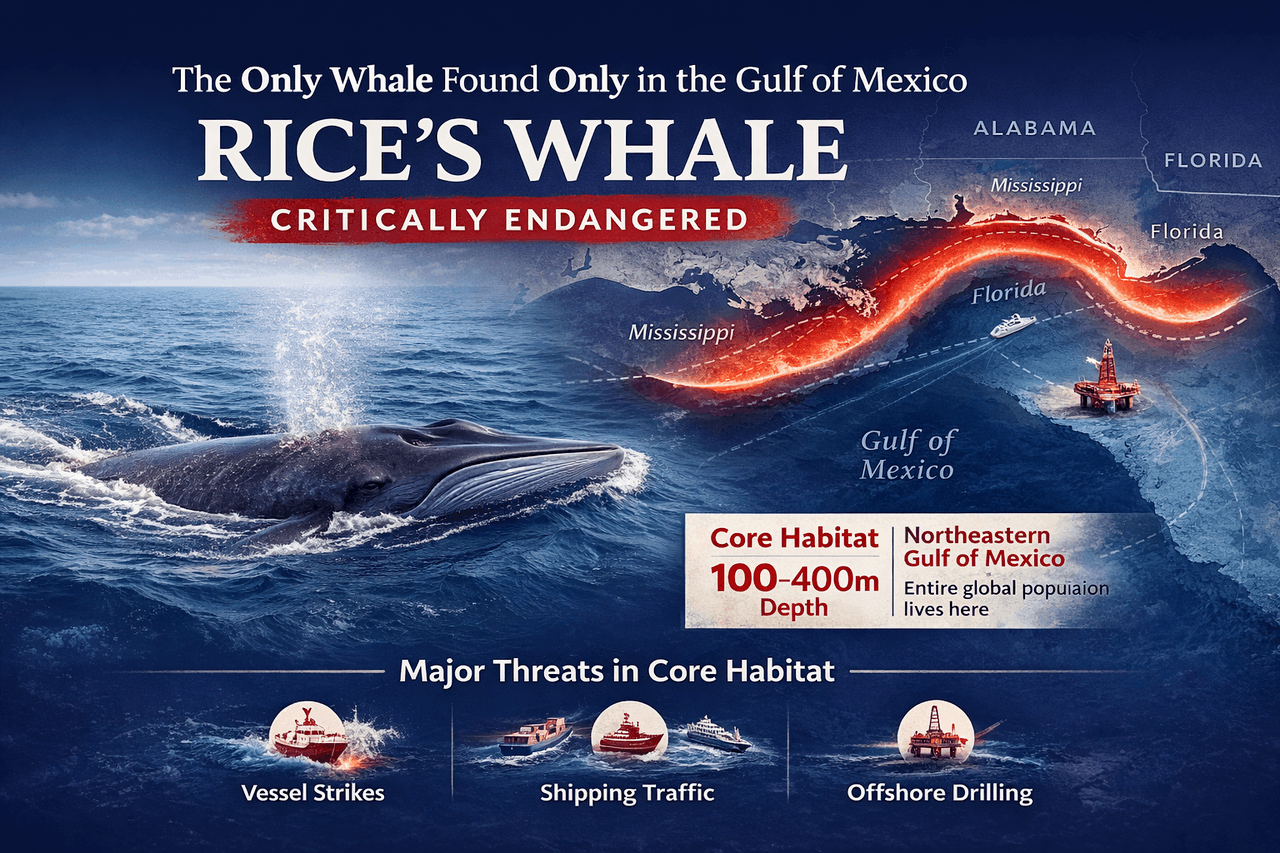
The Rice’s whale (Balaenoptera ricei) is a recently described species of baleen whale found exclusively in the Gulf of Mexico. Sleek and streamlined, these whales have a dark grey upper body contrasted by a pale to pink underside. One of their most distinctive features is the trio of parallel ridges running along their rostrum. Adult Rice’s whales can reach lengths of up to 41.5 feet and weigh between 13.87 and 27.2 metric tons (30,578–59,965 lbs.).
Historical accounts suggest that these whales were likely first observed by American whalers operating in the Gulf during the 1780s. Scientifically, however, the species’ story began in the 1960s when marine biologist Dale Rice documented them—though he initially identified them as a population of the closely related Bryde’s whale (Balaenoptera brydei). A genetic study in 2014 confirmed that the Gulf whales represented a unique lineage, but they were still classified as a subspecies of Bryde’s whale at that time. Finally, in 2021, new genetic evidence confirmed that these whales constitute a completely distinct species. Rice’s whales are now recognized as the only baleen whale species that inhabits the Gulf of Mexico year-round.
At the time of this writing, their known range includes the U.S.-controlled portions of the Gulf, though they show a strong preference for deepwater habitat—particularly undersea canyons at depths of 100–400 meters (330–1,300 feet).
Habitat of Rice’s Whales
( Balaenoptera ricei )
At the time of this writing, their known range includes the U.S.-controlled portions of the Gulf, though they show a strong preference for deepwater habitat—particularly undersea canyons at depths of 100–400 meters (330–1,300 feet).
How you can help!
Send the sample letter below to your local representative
Dear Member of Congress,
We appreciate your strong stances for animals, through your office, or as a member of the Animal Protection Caucus. The Rice’s Whale is on the brink of extinction.
Fewer than one hundred individuals remain. What happens in the next few years will determine whether this species survives or disappears forever. Extinction is forever.
This crisis is not only about one whale species. It is about whether we choose to protect life in the Gulf of Mexico or continue industrial practices that cause irreversible harm. Healthy oceans stabilize climate, sustain coastal communities, and support the living systems we all depend on. When oil and gas drilling, high speed vessel traffic, and military testing continue in known whale habitat, the damage extends far beyond a single species.
Protecting marine life is inseparable from protecting ourselves.
I respectfully and urgently urge you to support the following actions:
• Establish and enforce critical habitat protections for Rice’s whale no later than 2026, as required under the Endangered Species Act
• Mandate and enforce year round vessel speed limits of 10 knots in non emergency circumstances within whale habitat
• Permanently prohibit oil and gas drilling in the Eastern Planning Area of the Gulf of Mexico
• End military testing and other high intensity industrial activities within known Rice’s whale habitat
These measures are science based, legally grounded, and morally necessary. Choosing delay is choosing extinction.
Future generations will remember whether we acted when there was still time.
Please choose protection, responsibility, and life.
Sincerely,
[Name] [City, State]
SHARE OPERATION
GULF GUARDIANS
Key References:
Rosel, P. E., & Wilcox, L. A. (2014). Genetic evidence reveals a unique lineage of Bryde’s whales in the northern Gulf of Mexico. Endangered Species Research, 25, 19–34. https://doi.org/10.3354/esr00606
Rosel, P. E., Wilcox, L. A., Yamada, T. K., & Mullin, K. D. (2021). A new species of baleen whale (Balaenoptera) from the Gulf of Mexico, with a review of its geographic distribution. Marine Mammal Science, 37(2), 577–610. https://doi.org/10.1111/mms.12776
Additionally Resources:
Photo credit:
Rice’s whale,”Ms. Clean” showing a clear view of the dorsal fin. Credit: NOAA Fisheries/Laura Dias (Permit #21938)