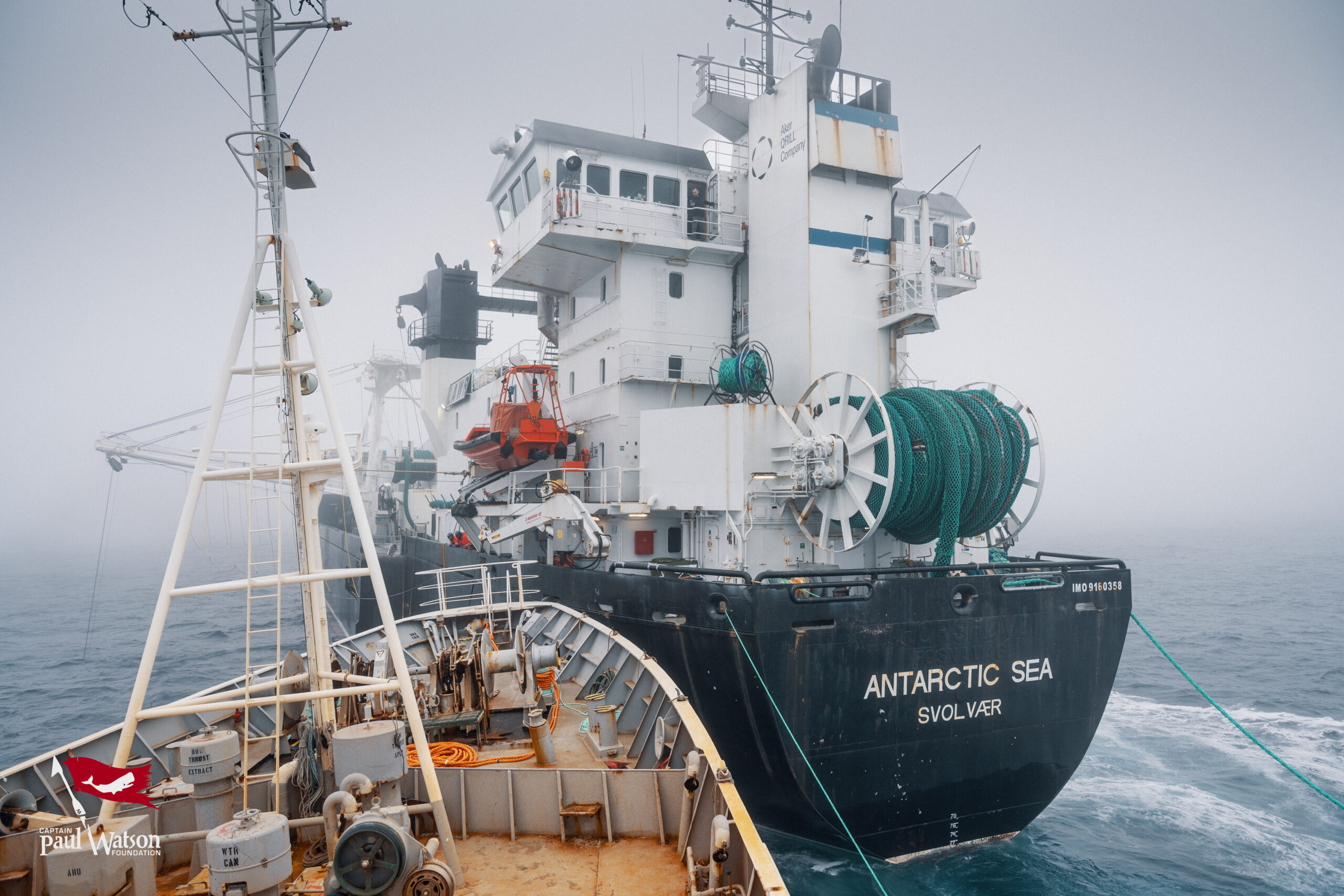
Antarctica — 31 March 2026 — The Captain Paul Watson Foundation crew, led by campaign leader Lamya Essemlali aboard the vessel Bandero, carried out a direct intervention targeting an industrial krill trawler operated by Aker Qrill.
Aker Qrill is currently the largest harvester of Antarctic krill, accounting for more than 60% of the total catch quota.
Over the course of more than five hours, the Bandero disrupted krill fishing operations involving two industrial vessels, repeatedly intervening to disable their activities. During the encounter The Captain Paul Watson Foundation obstructed their ecologically damaging activities to defend the primary food source of the Antarctic.
Throughout the encounter, the crew witnessed Antarctic wildlife in the surrounding waters, including penguins, seals, and even a whale, underscoring what was at stake as a small ship challenged a powerful industrial krill operation in a stark David-and-Goliath scenario.
Captain Paul Watson has said that the time for photos is over now is the time for action and this first intervention stands as proof of that shift.
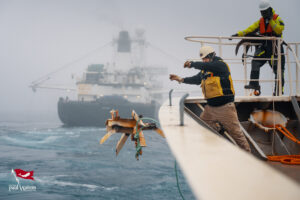
Photo Credit : Soizic Roux. Captain Paul Watson Crew
“Since 2018, environmentalists have been documenting and exposing this destruction year after year, but documentation alone has not stopped it,” said Captain Paul Watson. “At some point, you have to say enough is enough.”
Lamya Essemlali, speaking on behalf of the campaign, emphasized the urgency of the mission:
“Fishing for krill is an ecological time bomb. Nothing can justify targeting a keystone species on which the entire Antarctic ecosystem depends.”
The mission employed a strategy described as “aggressive nonviolence,” a tactic used for decades to directly disrupt activities such as whaling, sealing, and dolphin hunting while avoiding harm to human life. Watson, known for his long history of direct-action conservation campaigns, has stated his intent to end industrial krill trawling in Antarctic waters.
Last season, the catch quota of 620,000 tonnes of krill was reached for the first time. Norway has since advocated increasing the annual catch limit to as much as 1.2 million tonnes.
The krill are taken directly from the feeding grounds of whales, seals and penguins and expanding krill extraction poses a serious threat to the Antarctic ecosystem. Krill are a foundational species, serving as the primary food most marine life, without krill the entire food chain would collapse.
Krill oil is primarily used in omega-3 supplements, aquaculture and salmon feed, and pet food products. Critics also point to the environmental impacts of industrial salmon farming, a major consumer of krill-based feed, which has been widely criticized for its effects on wild fish populations and marine ecosystems.
Captain Paul Watson was detained in Greenland for five months under an Interpol Red Notice that Interpol later dismissed as being politically motivated because of his interventions against illegal Japanese whaling operations in the Southern Ocean. He has since redeployed his crew to the region, stating that protecting whales also requires protecting their primary food source.
For additional photos > https://jolly.cpwf.ngo/s/W9Ez6kKXJpt6sgG
—-ENDS—
Media Contact